 The BRICS Times
As the US-Iran conflict rattles energy supply chains across West Asia, Prime Minister Narendra Modi’s Abu Dhabi stopover cements two landmark agreements locking in India’s LPG lifeline and bulking up its strategic crude reserves against a potential Strait of Hormuz shutdown.

Modi Lands in UAE Amid Heightened Energy Anxiety
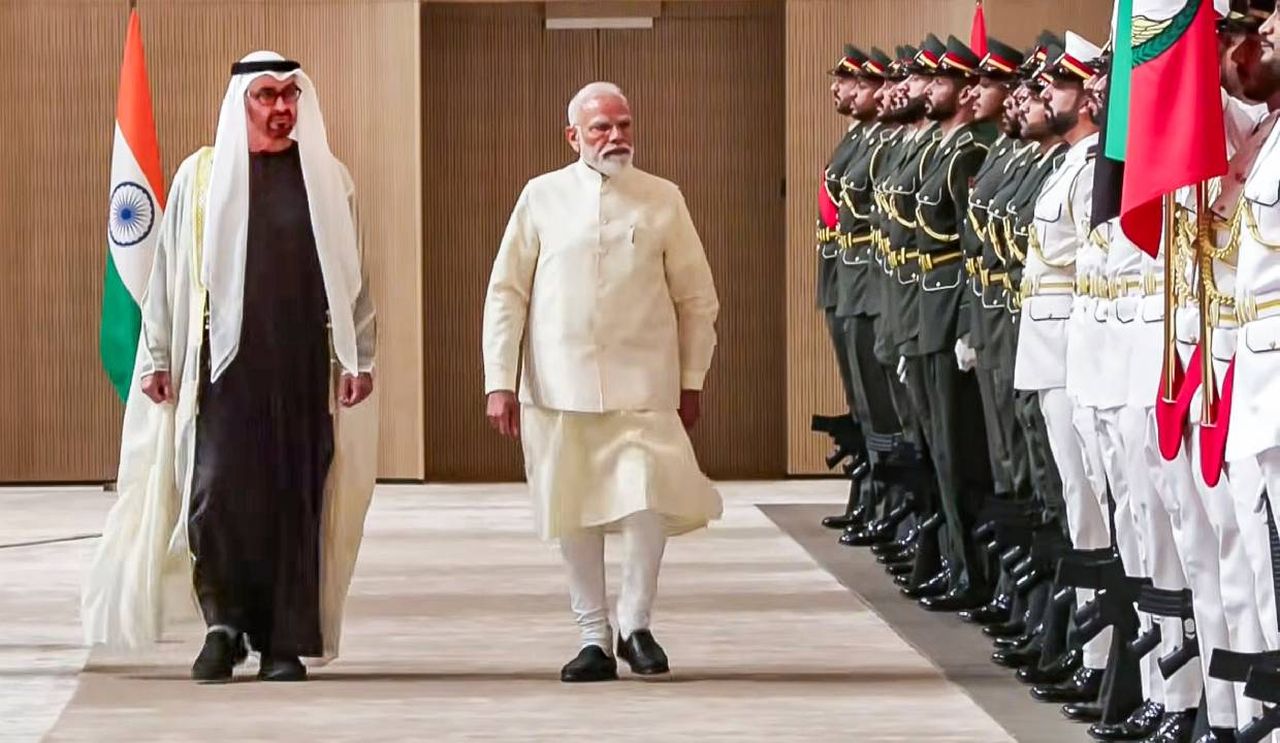
Prime Minister Narendra Modi touched down in Abu Dhabi on Friday, May 15, as the first stop of his five-nation tour spanning the UAE, the Netherlands, Sweden, Norway, and Italy. The visit reportedly added to the itinerary late carries enormous strategic weight. Two major agreements one covering liquefied petroleum gas (LPG) supply and another on strategic petroleum reserves are expected to be signed during his talks with UAE President Sheikh Mohammed bin Zayed Al Nahyan.
The timing could not be sharper. India’s energy imports from the Gulf face serious disruption risks driven by the widening US-Iran conflict. With the Strait of Hormuz under threat, New Delhi is racing to cushion its oil and gas supply chains.
Also Read | Modi’s Aircraft Gets Royal F-16 Fighter Jet Welcome as He Lands in Abu Dhabi
Why the Strait of Hormuz Threat Changes Everything for India
The Strait of Hormuz is the world’s single most critical oil chokepoint. A vast share of India’s crude oil and LPG moves through this narrow passage. Any disruption there could trigger fuel shortages and price shocks across the country.
On May 4, Iran launched ballistic missiles and drones targeting the UAE’s Fujairah port a key Gulf of Oman oil-loading hub that sits outside the Strait. Three Indian nationals were wounded in the attack. Prime Minister Modi condemned the strikes sharply saying that “safe and unimpeded navigation through the Strait of Hormuz is vital for enduring regional peace, stability and global energy security.”
India and the UAE have since explored contingency routes loading oil and LPG shipments directly from Fujairah, completely bypassing the Strait. This would require expanding the Fujairah oil terminal’s capacity and laying an additional cross-peninsula pipeline from Abu Dhabi’s Habshan terminal onward to Fujairah alongside the existing 406-km pipeline that already links Abu Dhabi’s oil fields to Habshan.
The LPG Deal: Protecting India’s Cooking Gas Supply
The UAE is India’s single largest supplier of LPG meeting close to 40 per cent of the country’s total requirement. Any disruption to that supply would directly hit Indian households, particularly those dependent on subsidised cooking gas connections.
The LPG agreement expected during Modi’s visit is designed to lock in long-term, stable supply arrangements. Indian companies and ADNOC Gas already hold cumulative long-term agreements for 4.5 million metric tonnes per annum (mmtpa) of LNG making India the largest buyer of UAE LNG. The fresh LPG pact builds further on this partnership, giving New Delhi far greater supply certainty during volatile times.
Strategic Oil Reserves: A Critical Buffer Gets Bigger
The second agreement relates to India’s strategic petroleum reserves the country’s emergency crude oil storage system. The UAE holds the unique distinction of being the first and so far only foreign nation to store oil inside India’s strategic caverns.
Back in 2018, the Indian Strategic Petroleum Reserves Limited (ISPRL) and the Abu Dhabi National Oil Company (ADNOC) signed a landmark agreement allowing the UAE to store over 5 million barrels of crude oil inside ISPRL’s underground cavern facility at Mangaluru. The new pact during Modi’s visit is expected to expand this arrangement potentially adding storage at newer facilities, including the Padur and Chandikhol strategic reserve sites currently under development.
Under these reserve-sharing agreements, India holds first-right access to the stored crude during any emergency a powerful hedge against sudden supply cuts.
Senior Diplomats Laid the Ground Weeks in Advance
The energy push did not happen overnight. External Affairs Minister S Jaishankar, National Security Adviser Ajit Doval, and Foreign Secretary Vikram Misri all visited the UAE separately over the past month building the diplomatic groundwork ahead of Modi’s arrival. The coordinated pre-visit engagement signals how seriously New Delhi is treating the energy security challenge.
India’s Petroleum Minister Hardeep Singh Puri separately confirmed this week that India currently holds about 60 days of crude and LNG reserves, and 45 days of LPG stock. “There is no supply problem,” Puri said though the agreements being pursued clearly aim to keep it that way.
UAE Stands as a Pillar of India’s Energy Architecture
The numbers tell the story plainly. The UAE was India’s fourth-largest crude oil source last year fulfilling nearly 11 per cent of total requirements. It is India’s third-largest LNG supplier and the largest LPG source. India also exports over $6 billion worth of petroleum, oil, and lubricants (POL) to the UAE annually making the Gulf nation the second-largest destination for Indian refinery exports.
Indian companies have invested more than $1.2 billion in UAE upstream energy assets. In 2018, a consortium of OVL, BPRL, and IOCL acquired a 10 per cent stake in the Lower Zakum offshore block. In 2019, Urja Bharat Private Limited a joint venture of BPRL and IOCL acquired a stake in Abu Dhabi’s Onshore Block-1. In January 2026, BPRL confirmed an oil discovery in that block the first successful upstream investment by an Indian company in West Asia.
Green Energy and Blue Economy on the Table Too
Beyond fossil fuels, the two sides are expanding into renewable energy cooperation. In October 2024, Abu Dhabi’s Masdar and the Rajasthan government inked an agreement for 60 gigawatts of renewable energy capacity. A feasibility study on grid interconnection between the two countries is also underway.
The UAE is also a founding member of the Global Biofuels Alliance launched during India’s G20 Presidency in September 2023. Officials from India’s Ministry of External Affairs said several additional agreements related to green energy transition technology and the blue economy are expected to be concluded during Modi’s UAE stopover.
From UAE, Modi Heads to Europe on a Packed Diplomatic Sprint
After Abu Dhabi, Modi travels onward to the Netherlands from May 15 to 17 where agreements on emerging technologies, including a likely update to the Tata Group’s partnership with Dutch semiconductor giant ASML for the Dholera chip fabrication plant, are expected.
Sweden follows from May 17 to 18 including a visit to Gothenburg, Scandinavia’s largest port and Volvo’s birthplace as Modi seeks to boost bilateral trade currently valued at around $2.73 billion. Norway comes next from May 18 to 19 marking the first Indian prime ministerial visit in 43 years with a key focus on attracting more investment from Norway’s Government Pension Fund Global, which currently holds close to $28 billion in Indian capital markets.
The tour concludes in Rome from May 19 to 20, where Modi will visit the headquarters of the Food and Agriculture Organization (FAO).