

 The BRICS Times
America’s naval blockade is choking Iran’s oil lifeline and sending food prices soaring. But Tehran has survived decades of US pressure before and may be wagering that Trump’s political troubles at home will force him to blink before Iran breaks.

Iran is hurting under the US naval blockade but its leaders may be counting on Trump to back down first
America’s naval blockade is choking Iran’s oil lifeline and pushing food prices higher. Tehran has survived decades of US pressure before and may be wagering that Trump will blink first.
A United States naval blockade on Iran is squeezing the Islamic Republic’s key economic arteries. Tehran now faces a looming oil storage crisis. Its 92 million citizens are struggling with soaring food costs and rising joblessness.
Yet Washington faces a tough road ahead. Unless it keeps this naval blockade running for months, dismantling an Iranian economy built to withstand years of US pressure will be nearly impossible. Iran’s leaders know Trump is fighting battles on the home front too. Midterm elections are approaching fast. Tehran may well be calculating that he will cave before they do.
Just three months ago, the Iranian government teetered on the edge of collapse. Angry citizens flooded streets nationwide, furious over the government’s mismanagement of the economy. Then the US and Israel launched their attacks. That gave the government an unexpected lifeline. Now Tehran uses the war as justification for every economic failure facing its people.
“Iran had already faced the maximum pressure campaign in Trump’s first term, and it was forced to cut its oil production by half,” said Esfandyar Batmanghelidj, CEO of think-tank Borse and Bazaar.
“If the blockade is in place for months, it will definitely impact the economic outlook for Iran, but the Iranian expectation is that the US itself cannot tolerate that pressure for that long.
‘Nothing in. Nothing out’
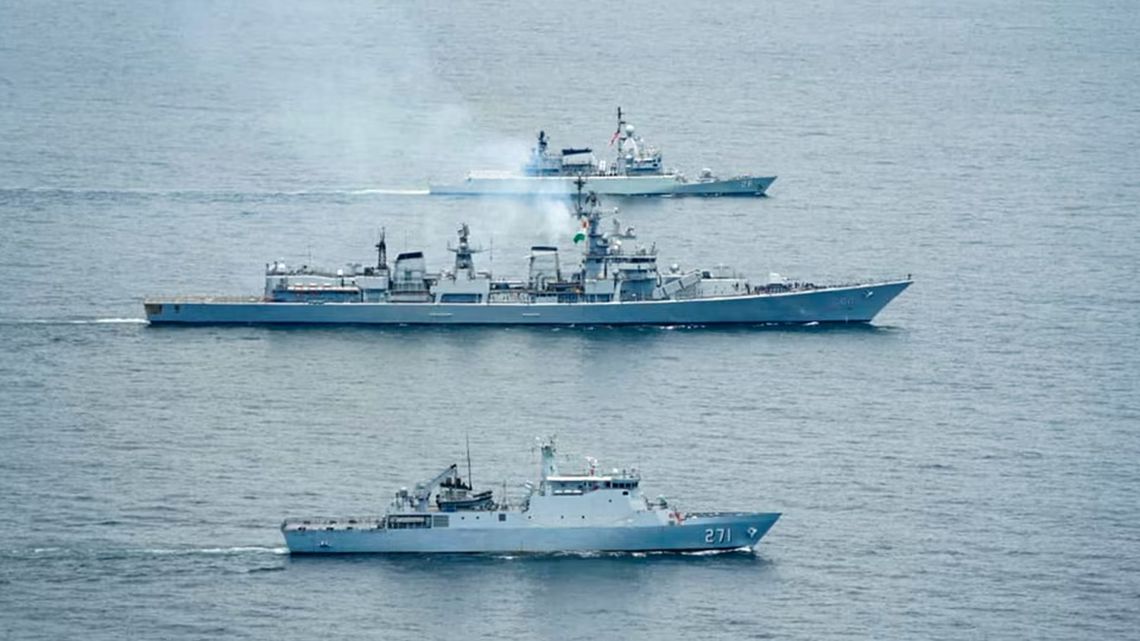
What started as a blockade of Iranian ports over ten days ago has since gone global. Every ship with ties to Iran now faces intense scrutiny from US naval forces throughout its entire voyage.
One of the blockade’s central goals is crippling Iran’s ability to export oil, its most vital commodity. If the country cannot move the millions of barrels it produces each day, production cuts become unavoidable. Crude oil and petroleum products are Iran’s primary source of foreign currency, and losing that income hurts badly.
Iran could probably keep its current oil production running for another two to three months before storage becomes “a significant consideration,” Batmanghelidj said.
Shipping analytics firm Kpler noted Iran still has around 30 million barrels of onshore storage headroom. That buys it a few more weeks before hitting its limit. Tehran could stretch that timeline further by finding new ways to offload stored oil.
One option Iran is actively exploring involves repurposing retired crude tankers. A 30-year-old large carrier called NASHA was spotted sailing toward oil storage terminals on Kharg Island. It may be taking on oil there and serving as floating storage, according to maritime intelligence company Tankertrackers.com.
Until a ceasefire took effect on April 7, the US and Israel had been hitting Iran with near-daily strikes. These attacks killed senior officials and targeted key infrastructure including steel plants, petrochemical facilities and major highways connecting cities.
One major US war aim was reopening the Strait of Hormuz. But when Iranian negotiators failed to reach a deal with their American counterparts this month, President Donald Trump changed his approach entirely. He launched what his Defense Secretary Pete Hegseth described as an “iron-clad” naval blockade stretching from the Gulf of Oman to the open oceans.
“To the regime in Tehran, the blockade is tightening by the hour. We are in control. Nothing in. Nothing out,” Hegseth told reporters on Friday.
The US move directly responded to Tehran’s decision to seal the Strait of Hormuz and charge an unofficial toll on ships passing through. The Strait handles more than a fifth of the world’s oil and gas exports, and shutting it sent energy prices spiking worldwide.
“The Strait cannot operate under threat. And let’s call payment for safe passage what it is: A protection racket. Hormuz belongs to the world. It must be returned to the world. Exactly as it was,” said Sultan Al Jaber, CEO of Abu Dhabi’s state oil giant ADNOC.
Southern Iran forms the backbone of the country’s entire trade and economic structure. It handles the great bulk of oil exports through coastal terminals. While Iran does have land borders for some overland trade, nothing rivals the southern coastline in economic importance. Kharg Island alone ships around 90% of Iran’s crude. Other coastal sites give Tehran additional options for moving oil past the Strait of Hormuz.
The US naval blockade now clamps down heavily on these southern terminals, even reaching far beyond the Strait. The conflict has also rattled global supplies of aluminum, plastics and rubber. The Middle East ships roughly 25% of the world’s polypropylene and 20% of its polyethylene, two of the most widely used plastics. The region also accounts for a quarter of global sulphur output and 15% of worldwide fertilizer production.
Hegseth confirmed that ships coming from or heading to Iranian ports are being turned back. By Friday, 34 vessels had been intercepted in the region. Two additional Iranian-linked ships were seized in the Indo-Pacific. Publicly, the US insists it will not stand down.
“A blockade as long as it takes, whatever President Trump decides,” Hegseth said.
Be considerate, Supreme Leader says
If Iran is forced to reroute imports through land borders or the Caspian Sea in the north, prices of goods could jump even higher than they already have.
Iran’s deputy labor minister Gholamhossein Mohammadi stated through state-affiliated media that one million jobs have already vanished. Two million more workers have seen their employment disrupted by the war. Another 130,000 factory workers lost their jobs after their workplaces were struck, Labor Ministry official Alireza Mahjoub told the Iranian Labour News Agency.
The government maintains that no goods shortages exist. It insists that despite “pressures, sanctions, and maritime restrictions,” Iran’s food supply chain continues to function, with 85% of agricultural products and essential goods produced domestically.
A resident of Tehran confirmed to reporters that market shelves remain stocked. But prices for basics like chicken, rice, eggs and medicine have tripled or even quadrupled. While rising gas prices alarm many American voters, Iranians have lived through hardship many times before.
“For Iran’s leadership the goal during war is not to run a normal economy,” Batmanghelidj said. “The goal is just to keep the economic machine going as well as possible for as long as possible and I think they can probably manage that.”President Masoud Pezeshkian acknowledged some fuel shortages that require “careful planning” and “public cooperation,” but praised the government’s response as “divine grace.”
Iran’s new Supreme Leader Mojtaba Khamenei, who has not appeared in public since taking office last month, issued a written statement asking citizens “to be considerate of one another so that the pressures caused by shortages, which are a natural effect of any war, are reduced on different segments of society.”
This weekend brought tentative signals of movement on the diplomatic front. US envoys are expected to follow Iran’s top diplomat to Pakistan, where mediators are eager to revive negotiations. But Tehran has weathered decades of American hostility. Unlike Washington, it is playing a longer game and has far more than short-term concerns on its mind.

 Aditya Didwaniya
 Akshay Didwaniya
 Mayur Mohta

 Pratik Agrawal