 The BRICS Times
Centre blames Sonam Wangchuk for sparking unrest, claiming his remarks incited mobs, while he ended his fast and left quietly.
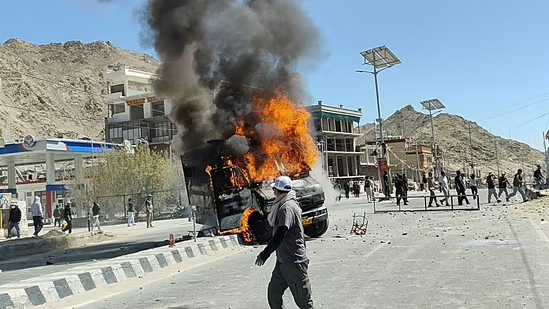
Ladakh’s long-standing statehood demand exploded into Leh Protest violence on Wednesday, leaving four people dead and over 60 others injured, including 30 security staff.
Officials described it as the region’s worst day of unrest in recent years, marked by street clashes, arson, and large-scale destruction. Protesters torched the BJP office in Leh, damaged several vehicles, and targeted public buildings as the agitation for statehood spiraled out of control.
Later in the evening, climate activist Sonam Wangchuk announced the end of his two-week hunger strike supporting statehood and the inclusion of Ladakh under the Sixth Schedule.
Shops stayed closed in the morning as Leh observed a complete shutdown. The agitation then snowballed into widespread chaos.
The district administration quickly enforced restrictions under Section 163 of the BNSS, prohibiting gatherings of five or more people. Congress councillor Phuntsog Stanzin Tsepag was also charged for an alleged provocative speech delivered a day earlier at the hunger strike site.
Protest turns violent
The flashpoint began after the Ladakh Apex Body’s youth wing called for mass protests. This came when two of the 15 activists on a 35-day hunger strike since September 10 were rushed to hospital as their health deteriorated.
The hunger strike was meant to push the Centre to act on a four-point demand list. This included full statehood, Sixth Schedule extension, separate Lok Sabha seats for Leh and Kargil, and job reservations.
Responding to the call, Leh town witnessed a complete bandh on Wednesday. Crowds gathered at the NDS Memorial Ground before marching through streets, chanting slogans in favor of the Sixth Schedule and statehood, officials told PTI.
The protest soon turned ugly when groups of youth hurled stones at the BJP office and the Hill Council building. Security forces deployed in large numbers fired teargas shells to disperse the crowd.
The violence unfolded just days before scheduled talks on October 6 between the Ministry of Home Affairs and Ladakh representatives, including the Ladakh Apex Body and the Kargil Democratic Alliance.
Centre’s reaction to Leh protests
According to the Ministry of Home Affairs, Sonam Wangchuk started his hunger strike on September 10, 2025, seeking statehood and Sixth Schedule safeguards for Ladakh.
The ministry said the Government of India has been engaging with both the Ladakh Apex Body and the Kargil Democratic Alliance. Several rounds of talks have already been held under the high-powered committee and its sub-panel, along with informal discussions with local leaders.
“The process of dialogue through this mechanism has yielded phenomenal results by increasing reservations for Ladakh scheduled tribe from 45% to 84%, providing 1/3 women reservations in the councils and declaring Bhoti and Purgi as official languages. With this process for recruitment of 1800 posts was also commenced,” the ministry’s statement said.
Officials stressed that Wangchuk’s demands were already part of ongoing discussions. Despite repeated requests to end his fast, he allegedly continued to provoke the public by invoking “Arab Spring-style protests” and making “references to Gen Z protests in Nepal.”
“It is clear that the mob was incited by Shri Sonam Wangchuk through his provocative statements. Incidentally, amidst these violent developments, he broke his fast and left for his village in an ambulance without making serious efforts to control the situation,” the statement said.

 Aditya Didwaniya
 Akshay Didwaniya

 Mayur Mohta