

 The BRICS Times
Taliban spokesperson Zabihullah Mujahid reported on X that the quake, with its strongest tremor measuring magnitude 6.0, destroyed more than 5,400 homes, leaving thousands of families displaced in the most affected areas.
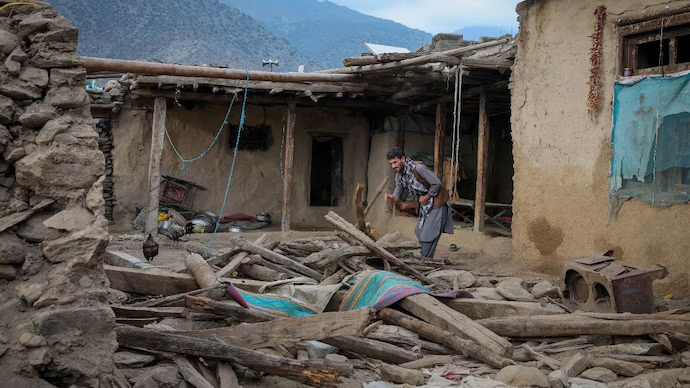
The devastating earthquake that struck Afghanistan on September 1 has left at least 1,411 people dead and over 3,100 injured, according to Taliban government spokesman Zabihullah Mujahid.
In a statement shared on X, Mujahid confirmed that the quake — the most powerful shock reaching magnitude 6.0 — demolished more than 5,400 houses, displacing thousands of families across the hardest-hit provinces.
Entire communities were reduced to rubble, with residents buried under collapsed homes made mostly from mud bricks and timber, which could not withstand the tremors.
Rescue teams are struggling to reach remote mountainous regions, where rough terrain has slowed down relief efforts. A UN official described the mission as a “race against time,” cautioning that the casualty figures could rise sharply.
“These are life-and-death choices as we try to reach survivors,” said Indrika Ratwatte, the UN’s resident coordinator in Afghanistan. He appealed to the global community not to overlook Afghanistan, already facing multiple crises. Ratwatte noted that the quake struck during the night, when most people were asleep, contributing to the high toll.
This marks the third major earthquake since the Taliban’s takeover in 2021. With limited international recognition — only Russia acknowledges the Taliban government — Kabul has urged for global assistance. However, aid to Afghanistan has been dwindling, strained by global conflicts, shrinking donor budgets, and international objections to the Taliban’s restrictions on women and girls, including bans on their work with aid groups.
Kate Carey, deputy head of the UN’s Office for the Coordination of Humanitarian Affairs in Afghanistan, highlighted the collapse of the healthcare system in the affected regions. She revealed that more than 420 health centres have either shut down or suspended services due to funding cuts, including 80 in eastern provinces near the quake’s epicentre.
“This has left the remaining facilities overwhelmed, under-resourced, and too far from the worst-hit communities — at a time when trauma care in the first 24 to 72 hours is most critical,” Carey explained.
Afghanistan is located in one of the world’s most seismically active zones, where the Indian and Eurasian tectonic plates collide. This geological pressure fractures and folds the Earth’s crust. In the Hindu Kush, it drives parts of the lithosphere deep into the mantle, making the Pamir-Hindu Kush region prone to powerful quakes, sometimes as deep as 200 kilometres — a rare global phenomenon. Meanwhile, in the Sulaiman Range along western Pakistan and southeastern Afghanistan, earthquakes are shallower and closer to the surface, often causing catastrophic destruction.


 Mayur Mohta
 Akshay Didwaniya

 Aditya Didwaniya