
 The BRICS Times
Costa and Von der Leyen stressed that the Ukraine war “carries global security consequences and undermines economic stability”, warning of risks for the entire world.
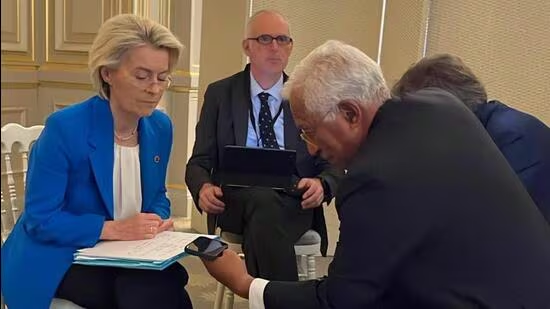
Senior leadership of the European Union (EU) reached out to New Delhi on Thursday, appealing for India’s intervention in encouraging Russia to halt the ongoing war in Ukraine. During a phone interaction, Prime Minister Narendra Modi reaffirmed that India has consistently stood by the principle of resolving the conflict through dialogue and peaceful means.
Alongside the focus on Ukraine, both sides also discussed the momentum around negotiations for the long-pending India-EU free trade agreement, with hopes of sealing the deal before the end of this year. The matter gained urgency following European Commission President Ursula von der Leyen’s visit to India earlier, when she was accompanied by nearly the entire EU College of Commissioners.
“India has an important role to play in bringing Russia to end its war of aggression and helping create a path towards peace,” António Costa and Ursula von der Leyen remarked in similar posts on social media after the exchange with Modi. They also welcomed India’s sustained engagement with Ukrainian President Volodymyr Zelenskyy.
According to a readout issued by India’s external affairs ministry, the leaders deliberated on several regional and global matters, with special emphasis on the Ukraine situation. Modi “reiterated India’s consistent support for peaceful resolution of the conflict and early restoration of peace and stability,” the statement highlighted, though without divulging detailed measures.
Costa and Von der Leyen underlined that the war in Ukraine “carries global security consequences and undermines economic stability”, posing a significant risk to the world at large. The Indian side’s readout stressed that both parties acknowledged the growing importance of the India-EU strategic partnership in jointly responding to global challenges, ensuring stability and further strengthening a rules-based order for common prosperity.
On the same day, External Affairs Minister S Jaishankar also engaged with his Ukrainian counterpart Andrii Sybiha. Sharing his views online, Jaishankar wrote that India “supports an early end to this conflict and the establishment of an enduring peace”. Their discussion additionally touched upon bilateral areas of cooperation.
In recent weeks, the spotlight on India’s role has intensified, with both Russian President Vladimir Putin and Ukraine’s Volodymyr Zelenskyy reaching out directly to Modi to discuss possible paths to peace. Modi also brought up the issue in his meeting with Putin during the Shanghai Cooperation Organisation Summit in China earlier this week, reiterating his position that wars cannot be settled on the battlefield and negotiations cannot succeed “under the shadow of the gun.”
The latest phone conversation came just two days before EU foreign ministers are due to meet in Copenhagen, where they are expected to deliberate on the bloc’s proposed “Anti-Circumvention Tool.” This mechanism, if activated, could pave the way for secondary sanctions on countries that help Russia gain access to restricted goods and resources despite Western embargoes. Meanwhile, India has also come under renewed scrutiny from the United States over its continued import of Russian oil, with energy security cited by New Delhi as the primary justification. Currently, Russian supplies account for nearly 40% of India’s oil requirements.
The Indian government’s readout also noted that both sides highlighted progress in cooperation across critical sectors including investment, technology, trade, defence, security, and supply chain resilience. The leaders “reaffirmed the shared commitment for an early conclusion of the India-EU FTA negotiations and implementation of the IMEEC [India–Middle East–Europe Economic Corridor] corridor.”
Costa and Von der Leyen echoed this determination in their online statements, declaring, “We also remain fully committed to concluding the Free Trade Agreement negotiations by the end of the year. To achieve this, progress is needed now.” So far, India and the EU have conducted 12 rounds of discussions on the pact, the most recent taking place in July.
Looking ahead, the leaders also deliberated on organising the upcoming India-EU Summit in India at the earliest opportunity. Modi extended a formal invitation to Costa and Von der Leyen, with both parties agreeing to advance work on a joint strategic agenda for the high-level meeting.


 Mayur Mohta
 Akshay Didwaniya

 Aditya Didwaniya