 The BRICS Times
In his address to the virtual Brics Summit, Jaishankar said it was imperative that economic practices were fair, transparent and to everyone’s benefit.
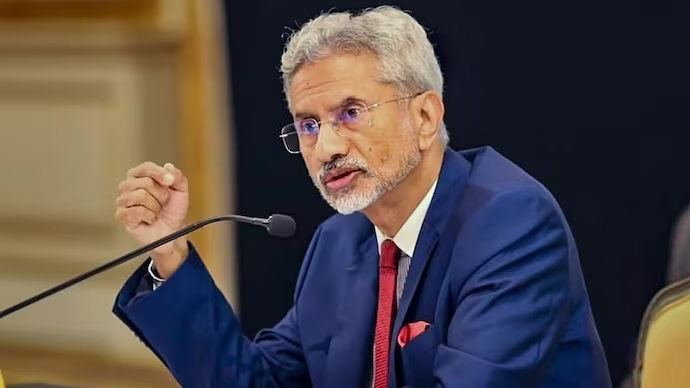
India on Monday urged the Brics forum to prioritise the stability of the global economy and safeguard the world order while firmly resisting unfair trade measures and the imposition of additional barriers. The call was made during a virtual meeting of the grouping of emerging economies, where discussions were centred on the economic consequences of tariff policies introduced by the Trump administration in the United States.
Representing India at the summit hosted by Brazilian President Luiz Inacio Lula da Silva, external affairs minister S Jaishankar underscored the necessity of preserving the international trading framework that is anchored in an open, transparent, equitable and rules-based structure. He also highlighted that such a system must remain non-discriminatory and supportive of developing countries.
The minister reminded participants that the grouping, which now includes members such as China, Iran and Russia, must also address the effects of conflicts in Ukraine and West Asia on the Global South. India and Brazil have both been subjected to 50% tariffs imposed by Washington, placing them among the hardest hit nations.
In his remarks, Jaishankar stressed that the current multilateral framework “appears to be failing” due to the aftermath of the pandemic, the wars in Ukraine and West Asia, volatile investment flows and intensifying climate disruptions. “Today, the focus is on stabilising the international economy and the world order,” he noted.
He reaffirmed that “the international trading system is based on the foundational principles of open, fair, transparent, non-discriminatory, inclusive, equitable and a rules-based approach with special and differential treatment for developing countries. India strongly believes that this should be protected and nurtured.” Without naming the US, Jaishankar pointed to the importance of “trade patterns and market access” as central topics in the global economic discourse.
The minister added, “The world requires constructive and cooperative approaches to promote trade that is sustainable. Increasing barriers and complicating transactions will not help. Neither would the linking of trade measures to non-trade matters,” a statement indirectly aimed at punitive US tariffs placed on Indian exports linked to its energy trade with Russia.
The Brics meeting took place amid heightened strains in India-US relations not seen in nearly two decades, as Washington regularly criticised New Delhi over ties with Moscow and its oil and defence deals. Jaishankar made clear that during this turbulent period, the world must ensure economic practices are “fair, transparent and to everyone’s benefit”. He further said, “When there are multiple disruptions, our objective should be to proof it against such shocks. That means creating more resilient, reliable, redundant and shorter supply chains.”
He added that global efforts should focus on “democratising manufacturing and production and encouraging their expansion across regions” to strengthen local self-reliance and reduce uncertainties in unpredictable times. According to him, the global order is already under heavy stress from ongoing conflicts, uneven trade flows and slow progress on sustainable development goals.
The minister argued that Brics nations, significantly impacted by these shifts, must work together to harmonise their policies and present collective responses. “Where India is concerned, some of our biggest deficits are with Brics partners and we have been pressing for expeditious solutions. We hope that this realisation will be part of the takeaways from today’s meeting,” Jaishankar stated.
He drew attention to how conflicts in Ukraine and West Asia have undermined food, fertiliser and energy security in the Global South. “Where shipping is targeted, not just trade but livelihoods also suffer. A selective protection cannot be a global answer. An early end to the hostilities and undertaking diplomacy to ensure a durable solution is the obvious pathway before us,” he explained.
Jaishankar pressed for reforms in global governance institutions, including the United Nations, which he said have been ineffective in addressing present-day challenges. He observed that “gridlocks have undermined the search for common ground” and called on Brics to become a “strong voice” demanding urgent reforms of multilateralism, the UN and its Security Council.
At the same time, he urged the bloc to remain attentive to long-term issues such as climate change, climate justice and sustainable development, where projects like the International Solar Alliance, Global Bio-fuels Alliance and Coalition for Disaster Resilient Infrastructure can play a decisive role.
Chinese President Xi Jinping also spoke at the summit, warning that hegemonism, unilateralism and protectionism are worsening worldwide. “Trade wars and tariff wars waged by some countries severely disrupt the world economy and undermine international trade rules,” he declared without naming the United States.
Xi further emphasised that Brics must uphold openness, inclusiveness and win-win cooperation. “At this critical juncture, Brics countries…should act on the Brics spirit of openness, inclusiveness and win-win cooperation, jointly defend multilateralism and the multilateral trading system, advance greater Brics cooperation and build a community with a shared future for humanity,” he said.
He also underlined that Brics should stay committed to a free and open world economy and support the World Trade Organization as the central institution of global trade. The grouping must challenge all forms of protectionism, promote inclusive globalisation and ensure the Global South is treated as an equal partner in international cooperation, Xi noted.

 Akshay Didwaniya
 Aditya Didwaniya
 Mayur Mohta
 Pratik Agrawal