 The BRICS Times
At present, BMC is following Bombay High Court orders by removing POP idols from the sea and recycling them.
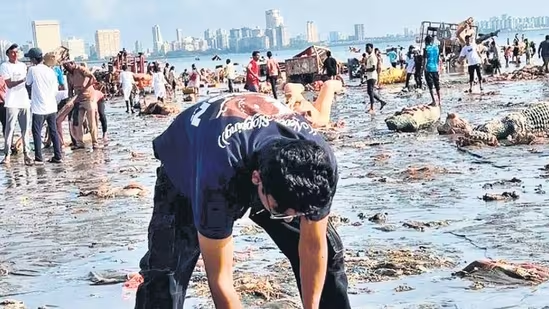
After the sea of devotion has settled, Mumbai has entered a new phase focused on protecting its environment. Following the directives of the Bombay High Court, the Brihanmumbai Municipal Corporation (BMC) has launched an initiative never seen before. After the Ganesh immersion ceremonies, huge quantities of Plaster of Paris (POP) debris washed up along the city’s shores. To address this, the civic body has started “Operation Recycle.” This year alone, nearly 1,982 metric tons, equal to around 20 lakh kilograms of POP waste, has been collected from the city.
How will this massive POP waste be destroyed?
To deal with such enormous debris, BMC deployed a fleet of 436 trucks working continuously to transport the waste to a processing unit in Bhiwandi. But only collecting the garbage is not enough. The real scientific challenge begins now. To find a permanent solution, BMC has sought the expertise of 12 premier research institutions, including IIT Bombay and VJTI. Based on their recommendations, BMC and the Central Pollution Control Board (CPCB) will determine the most suitable method for safely eliminating POP waste.
What was the High Court’s order?
In July 2025, the Bombay High Court issued significant rulings concerning POP idols. One directive allowed idols taller than six feet to be immersed in natural water bodies such as seas and rivers. However, it mandated that BMC must retrieve these idols after immersion and ensure their recycling. The court aimed to reduce environmental damage while maintaining the cultural traditions of the festival. The conditional approval granted by the High Court regarding POP idols was later taken up before the Supreme Court as well.
The issue before the Supreme Court
A petition was filed in the Supreme Court challenging the High Court’s decision that allowed the manufacture and immersion of POP idols. In the first week of September 2025, the apex court heard the matter and issued notices to the Maharashtra government, the State Pollution Control Board, and other municipal authorities. The court highlighted that CPCB’s 2020 guidelines imposed a complete ban on POP. It directed the state government to explain within four weeks how the High Court’s order could be justified despite those guidelines.
POP idols caught between art, economy, and environment
As per the High Court order, civic bodies like BMC have already collected thousands of tons of POP debris from immersion sites, which is now headed for recycling. Yet, POP idol production in Mumbai remains a deeply complex issue that lies at the intersection of art, tradition, economics, and ecology. Despite repeated attempts to ban POP for environmental reasons, thousands of families in and around Mumbai depend on idol-making for their livelihood. This centuries-old profession faces collapse if POP is completely prohibited.
Why the issue remains unresolved
A total ban on POP would devastate the entire economic system of artisans. Considering its environmental harm, multiple legal interventions were initiated. In 2020, CPCB released guidelines restricting the production, sale, and immersion of POP idols in natural water sources. Idol makers in Mumbai challenged these directions, leading to prolonged litigation in the Bombay High Court. After several hearings, the court opted for a middle path by granting conditional approval. Idols up to six feet must be immersed only in artificial ponds, while larger idols can go into the sea provided BMC removes them within 24 hours for recycling. Even today, this issue remains unsettled in court. On one side stands environmental safety, while on the other side are faith and the livelihoods of thousands.
Why POP idols are in high demand
The rising popularity of POP idols is linked to affordability and convenience. Compared to traditional “shadu” clay, POP is significantly cheaper, reducing the overall cost of idols and making them affordable for the common devotee. POP fits easily into molds, dries quickly, and hardens firmly, enabling faster production of intricate and eye-catching designs. POP idols are also lighter than clay idols, which makes transporting massive 20–30-foot idols to mandaps and later to immersion sites much easier. Currently, BMC is acting under High Court instructions to retrieve and recycle POP idols from the sea, but the long-term future of this process will depend entirely on the Supreme Court’s final verdict.


 Mayur Mohta
 Pratik Agrawal
 Akshay Didwaniya