
 The BRICS Times
The judges said the petitioners’ demands could hinder ongoing relief efforts, as officials would be diverted from disaster management to prepare replies.
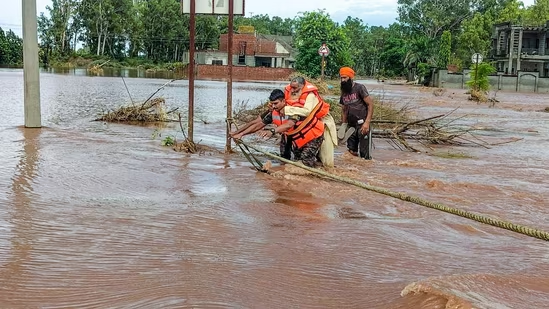
The Punjab and Haryana High Court on Monday asked the state government to provide an affidavit on measures taken for relief and rehabilitation of flood victims. However, the bench clarified that this affidavit should be filed only after six weeks, when the present flood emergency is expected to settle down.
This directive came during the hearing of a series of Public Interest Litigations (PILs) demanding guaranteed standards of assistance under Section 12 of the Disaster Management Act. These petitions sought provisions like proper food supply, clean drinking water, medical care, shelter, sanitation, and adequate lighting for people affected by floods.
Chief Justice Sheel Nagu and Justice Sanjiv Berry made it clear that the immediate focus must remain on disaster management, not court proceedings.
“The court made an earnest request to the petitioners to hold their hands till the crisis is over, but the petitioners insist that notice be issued. Instead of issuing notice, the court directs that the state file an affidavit, but only after the crisis of the flood situation is over. File after six weeks,” Live Law quoted the bench.
The judges observed that the continuous insistence of petitioners could disturb the pace of relief operations, since officers engaged in emergency response would be required to prepare legal responses.
“Disaster relief teams are there, the Army is there, everybody is working hard. Please don’t cause any obstruction. The moment we issue a notice, some people will be pulled out of disaster management and made to sit at a table to prepare a reply for these petitions,” said the bench.
Chief Justice Nagu further questioned the petitioners for doubting the active presence of the Army across districts. He noted, “You all even doubt the efforts of the Army, which is there. They are present in every district. We will ask for a response because of your insistence. In the crisis time, there is something else that is required. It is surprising that none of you is coming forward and saying, please defer it.”
The bench also recalled that the Supreme Court had earlier addressed similar environmental concerns. It referred to the Anamika Rana matter on September 4, which highlighted ecological damage in the Himalayan belt.
The High Court remarked, “We have seen unprecedented landslides and floods in Uttarakhand, Himachal Pradesh, and Punjab. From media reports, it is noticed that a huge number of timber logs were flowing in the floodwaters. Prima facie, it appears that illegal tree felling has been taking place across the hills.”
On the other hand, the petitioners requested that immediate notice be issued to the state for a detailed reply. They argued that the present disaster, especially in Punjab, is not only natural but partly “man-made” and hence requires judicial intervention without delay.
Counsel Gurmohan Preet also presented data from the 1988 Punjab floods, which affected nearly 9,000 villages, pointing out that the present situation shows alarming similarities to that earlier calamity.

 Aditya Didwaniya
 Akshay Didwaniya
 Mayur Mohta


 Pratik Agrawal