 The BRICS Times
Nepal travel advisory issued by MEA urges Indians to postpone visits as deadly unrest forces PM Oli to step down.
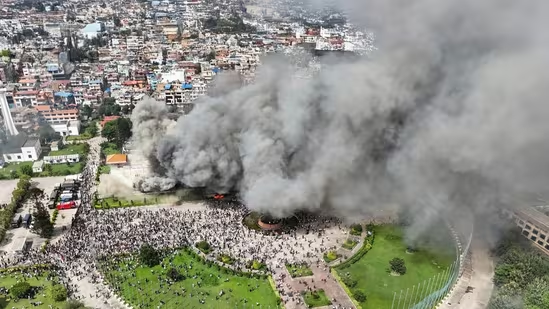
At least 19 people have lost their lives in Nepal after days of violent protests triggered by corruption scandals and a controversial social media ban. The unrest pushed Prime Minister KP Sharma Oli to resign, even as curfews were reimposed in Kathmandu and other cities.
On Tuesday, India’s Ministry of External Affairs (MEA) released a travel advisory asking its citizens to avoid visiting Nepal until the situation improves. Those already in the Himalayan nation were urged to stay indoors, avoid stepping out unnecessarily, and follow instructions from local authorities and the Indian Embassy in Kathmandu.
For help, Indian nationals can reach out to the embassy through these helplines:
📞 +977–980 860 2881 (WhatsApp available)
📞 +977–981 032 6134 (WhatsApp available)
The MEA said, “We are closely monitoring the developments in Nepal since yesterday and are deeply saddened by the loss of many young lives. Our thoughts and prayers are with families of the deceased. We also wish speedy recovery for those who were injured.”
“As a close friend and neighbour, we hope that all concerned will exercise restraint and address any issues through peaceful means and dialogue,” it added.
Oli Steps Down Amid Pressure
Prime Minister Oli, 73, resigned on Tuesday, telling President Ramchandra Paudel that he wanted to “facilitate the solution to the problem and to help resolve it politically in accordance with the constitution.” His resignation was accepted quickly, with discussions on a new leader already underway.
Following his move, the Nepal Army urged citizens on X (formerly Twitter) to “exercise restraint.” Oli, who began his fourth term just last July, held a meeting earlier that day with political parties where he said violence was “not in the interest of the nation.” He also blamed “infiltration from different selfish centres” for the protests, without directly addressing the corruption charges against his government.
Two of his cabinet ministers quit late Monday on moral grounds.
Worst Unrest in Decades
Organisers called the protests “demonstrations by Gen Z,” sparked after the government imposed a sweeping social media ban. The ban was lifted only after clashes killed 19 and injured over 100 people.
Protesters set tyres ablaze, hurled stones at police, and attacked homes of politicians in Kathmandu. Some ministers reportedly had to be airlifted by military helicopters. Authorities even shut down Kathmandu’s Tribhuvan International Airport after fires broke out near the area.
The unrest, the worst Nepal has seen in decades, was driven by anger over corruption and shrinking economic opportunities. “We are still standing here for our future … We want this country corruption-free so that everyone can easily access education, hospitals, medical (facilities) … and for a bright future,” protester Robin Sreshtha told Reuters TV.

 Akshay Didwaniya
 Mayur Mohta