The BRICS Times
“Field Marshal is a very great guy, and so is the Prime Minister, both, and they’re coming, and they may be in this room right now,” Trump told reporters, hinting at a rare warm welcome for Pakistani leadership in Washington.
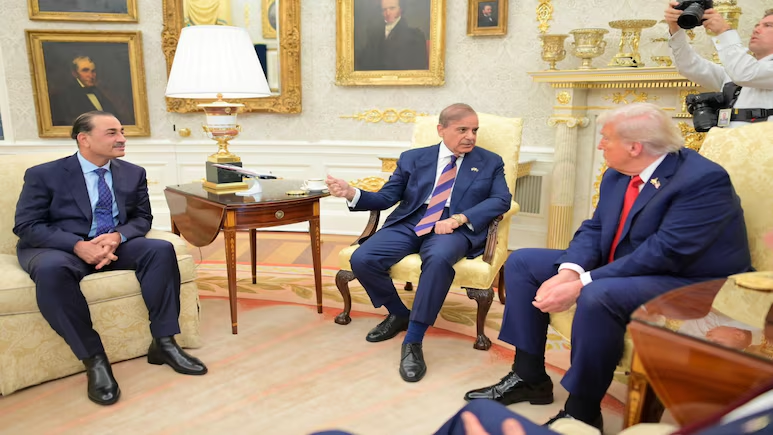
US President Donald Trump welcomed Pakistan’s Prime Minister Shehbaz Sharif to the Oval Office on Thursday. He was joined by Pakistan’s Army Chief, Field Marshal Asim Munir, who earlier this summer had lunch with Trump at the White House. US Secretary of State Marco Rubio was also present at the meeting.
Before the talks, Trump hailed the visitors as “great leaders,” signaling a positive shift in relations between Washington and Islamabad.
“We have a great leader coming, the Prime Minister of Pakistan, and the Field Marshal. Field Marshal is a very great guy, and so is the Prime Minister, both, and they’re coming, and they may be in this room right now,” Trump said, while interacting with reporters.
This meeting came soon after the US and Pakistan signed a new trade deal and followed a brief handshake between Trump and Sharif at the UN General Assembly in New York on Tuesday. During that gathering, Trump also met leaders from Egypt, Indonesia, Qatar, Saudi Arabia, Turkiye, and other Arab nations.
Sharif arrived at the White House at 4.52 pm, greeted by top officials from the US administration. At the time, Trump was signing executive orders and speaking to the media. The Pakistani premier’s convoy left the White House at 6.18 pm, according to official pool reports.
ANI reported that both Sharif and Munir had to wait nearly half an hour before meeting Trump, though NDTV could not independently confirm this. Pool photographs from the White House also showed the two waiting as the President wrapped up earlier commitments.
Thaw In US-Pak Relations
Historically, Washington relied on Pakistan as a strategic partner in South Asia, especially during the Soviet war in Afghanistan and later in the fight against terrorism. However, ties weakened over the years after repeated allegations of Pakistan supporting terror groups. The situation worsened when US forces found Osama bin Laden hiding in Abbottabad.
In 2018, Trump openly slammed Islamabad, saying it had provided Washington with “nothing but lies and deceit.” He declared, “We have been paying Pakistan billions and billions of dollars at the same time they are housing the very terrorists that we are fighting…It is time for Pakistan to demonstrate its commitment to civilisation, order, and to peace.”
Now, however, Islamabad is offering fresh incentives to Washington. Earlier this month, Sharif and Munir witnessed the signing of two new memorandums of understanding (MoUs). These included Pakistan supplying critical minerals and rare earth elements to the US. A US firm has pledged $500 million investment in Pakistan’s mineral sector. This followed Trump’s July promise to help Pakistan develop its vast oil reserves.
The latest trade pact imposes a 19 per cent tariff on Pakistani imports while allowing US support in oil exploration. Trade figures highlight the growing engagement. US goods and services trade with Pakistan touched $10.1 billion in 2024, up 6.3 per cent from the previous year.
Total goods trade stood at $7.2 billion in 2024. Exports to Pakistan rose to $2.1 billion, while imports increased to $5.1 billion. The goods trade deficit widened to $3 billion, reflecting a 5.9 per cent jump from 2023.
Washington has hosted Munir three times in recent months, indicating Islamabad’s new strategy is paying off. The visits also come against the backdrop of heightened tensions between India and Pakistan earlier this year.
The last Pakistani leader to meet Trump at the White House was Imran Khan in July 2019. Prior to that, Nawaz Sharif visited in 2015.
Observers also point to Trump’s self-claimed role in ending India-Pakistan hostilities as a reason for warming ties. India strongly rejected Trump’s claims, but Islamabad later embraced them, even nominating Trump for the 2026 Nobel Peace Prize for his “decisive diplomatic intervention and pivotal leadership during the recent India-Pakistan crisis.”


 Mayur Mohta
 Pratik Agrawal
 Akshay Didwaniya
 Aditya Didwaniya