
 The BRICS Times
The legendary MiG-21, India’s first supersonic fighter jet, ends its journey after six decades of service, bravery, and historic victories.
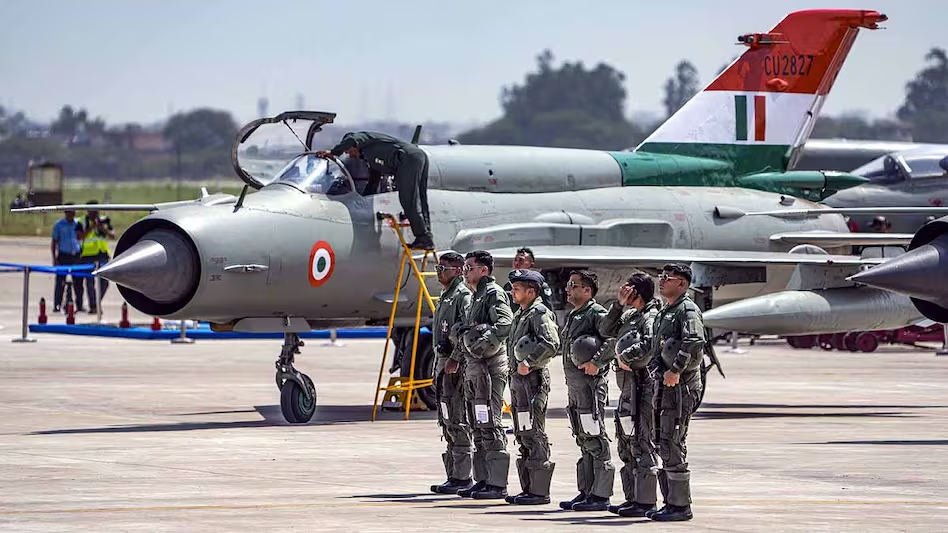
The MiG-21 became one of the most iconic fighter aircraft in aviation history. Built in the Soviet Union during the 1950s, it first took flight in 1955. This aircraft marked history as the world’s first supersonic jet capable of flying faster than the speed of sound. Known for its unmatched speed, the MiG-21 could soar to Mach 2. (Photo: PTI)

The MiG-21 had the unique ability to climb to higher altitudes quickly and intercept enemy planes with precision. Its legacy is not only about accidents, as often mentioned, but also about countless acts of valor and victories. Across several wars, it left adversaries stunned with its dominance. (Photo: PTI)

India acquired its first MiG-21 in 1963, a critical step after the 1962 war with China to strengthen the Air Force. Between 1966 and 1980, India inducted 872 MiG-21 aircraft, with Hindustan Aeronautics Limited in Nashik beginning local production. As India’s first supersonic fighter, it initially protected high skies but later proved equally effective in close-range dogfights and ground attacks. (Photo: PTI)

During the 1965 Indo-Pak war, India had limited MiG-21s and pilots were still under training. Despite this, the aircraft delivered valuable defensive operations. Following the Gnat fighters, the MiG-21 gradually established its superiority. For the Indian Air Force, this war became a learning ground for the MiG-21. (Photo: PTI)

The 1971 Indo-Pak war turned into the golden era for the MiG-21. Indian Air Force pilots flying MiG-21s dominated the western front and secured air superiority. They downed four Pakistani F-104 Starfighters, two Shenyang F-6, one F-86 Sabre, and one C-130 Hercules. Two F-104 kills were officially confirmed. (Photo: PTI)

In a historic first for the subcontinent, a MiG-21FL shot down a Pakistani F-104 using its GSh-23 cannon. After this defeat, Pakistan permanently grounded its Starfighter fleet. The MiG-21 also carried out daring night raids deep into Pakistani territory at low altitude. (Photo: PTI)

Flying from Amritsar, MiG-21s dropped 500-kg bombs on Dhaka’s Governor House, highlighting their versatility. These fighters played a crucial role in securing India’s victory. Beyond South Asia, the MiG-21 served many nations and fought in conflicts such as the Vietnam War and Middle East clashes, alongside its major role in Indo-Pak wars. (Photo: PTI)

Between 1966 and 1972, North Vietnam’s Air Force effectively used the MiG-21 against U.S. aircraft. Vietnamese pilots destroyed 165 enemy planes, including 103 F-4 Phantoms, though they lost 65 MiG-21s in the battles. (Photo: PTI)

After more than 60 years in service, the Indian Air Force is retiring the MiG-21 in 2025. For decades, it remained the backbone of India’s aerial power. Pilots trusted it despite challenges like high landing speed and no air-conditioning in hot weather. Its speed and climbing power made it a true legend of the skies. (Photo: PTI)


 Mayur Mohta
 Pratik Agrawal
 Akshay Didwaniya