 The BRICS Times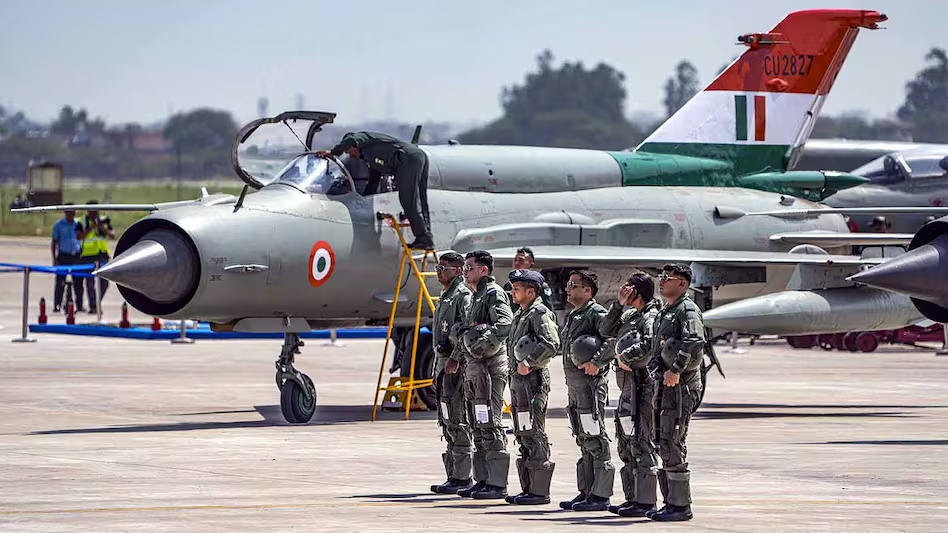
After September 26, MiG-21 Bison aircraft will fly from Chandigarh to Nal Airbase. With their retirement, Number 3 (Cobra) and Number 23 (Panthers) squadrons will be number-plated, preserving their legacy. Number 3 squadron will receive the first LCA Mark 1A. At Nal, after inspections, usable parts will be sent to colleges or museums, while the rest will be scrapped. Airframes will be available for display upon request to Air Headquarters.
MiG-21 Jets Retire After Six Decades of Service
The legendary MiG-21 fighter jets of the Indian Air Force have been officially retired from combat squadrons. On September 26, 2025, a grand farewell ceremony was held at Chandigarh, marking the end of their 62 years of service in defending India’s skies.
The final two squadrons – Number 23 “Panthers” and Number 3 “Cobras” – had about 28 MiG-21 Bison aircraft in operation. With their decommissioning, the IAF is now left with 29 active fighter squadrons, far below the required 42. The big question remains: what happens next to these iconic jets? They won’t be dumped in a junkyard; instead, they are set to find new roles in museums, academic institutions, and training facilities.
MiG-21 Retirement: The End of an Era
The MiG-21, designed by the Soviet Union, was the first supersonic fighter jet inducted into the Indian Air Force in 1963. India purchased 874 units in total. Over decades, it proved its might in the 1965 and 1971 wars, the 1999 Kargil conflict, and even the 2019 Balakot operation. However, aging technology and frequent accidents led to its retirement.
At Chandigarh Air Base, Air Chief Marshal A.P. Singh piloted the final solo sortie. The farewell included a water salute and a flypast, marking the jet’s official exit from frontline duty.

What Happens After Retirement?
The MiG-21 Bison jets will fly from Chandigarh to Nal Airbase for their post-service evaluation. Following retirement, Number 3 “Cobra” and Number 23 “Panthers” squadrons will be number-plated. This process ensures their heritage and names are preserved. Number 3 squadron is expected to induct the first LCA Mark 1A fighter jets.
At Nal, a detailed inspection will be conducted. Usable parts will be salvaged for training or museum purposes, while unusable components will be scrapped. Engineering colleges may request these parts for student training, while museums and war memorials can acquire them for public display.
Civilians or institutions interested in displaying a MiG-21 frame must apply to Air Headquarters. Applications undergo strict scrutiny, and only those meeting IAF standards will qualify. Typically, such aircraft frames are displayed in universities, industries, and government establishments.

MiG-21s on Display Across India
Several retired MiG-21s have already been showcased in museums nationwide. A single-seater MiG-21 is displayed at the Indian Air Force Heritage Centre in Chandigarh, the first such heritage facility in India. Other MiG-21 variants are displayed at the IAF Museum in Delhi, outside Palam Air Force Station, near Nicco Park in Kolkata, at HAL’s Biju Patnaik Aeronautics Museum in Odisha, the Rashtrapati Bhavan Museum in Delhi, Chandrashekhar Park in Prayagraj, and the HAL Heritage Centre and Aerospace Museum in Bengaluru.

Jets Reborn as Training and Target Drones
Some retired aircraft will be converted into supersonic target drones, offering realistic combat training for IAF pilots. This transformation gives a new technical life to the MiG-21 legacy.
As per Air Force rules, institutions receiving these airframes must ensure proper upkeep. The aircraft must retain its IAF paint scheme. In cases where state governments acquire them for cities, municipal bodies will assist in maintenance to prevent decay.
The Future of MiG-21 Pilots
Typically, fighter pilots cannot arbitrarily switch their flying streams. Pilots in the fighter stream may move to transport or helicopter divisions under specific conditions, often on medical grounds. With the MiG-21’s phase-out, its pilots now have the option to transition.
After primary training, IAF pilots specialize in different aircraft. For MiG-21 pilots moving to other fighters, a three to six-month retraining program is mandatory due to aircraft differences. Many may also become test pilots, or shift to logistics and administrative branches.

 Aditya Didwaniya
 Akshay Didwaniya


 Mayur Mohta