 The BRICS Times
PM Modi made these remarks at the SCO opening session, which Pakistan’s Shehbaz Sharif is also attending.
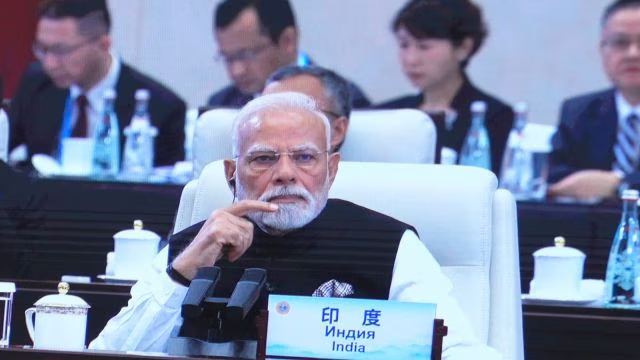
At the Shanghai Cooperation Organisation (SCO) summit on Monday, Prime Minister Narendra Modi strongly condemned the recent terror strike in Pahalgam, calling it “not just an assault on India’s conscience but also a direct challenge to humanity as a whole.” He warned that the world must reject “double standards on terrorism.”
Speaking at the opening session, chaired by Chinese President Xi Jinping and attended by Pakistan’s Prime Minister Shehbaz Sharif, Modi outlined India’s approach to the SCO under three pillars — Security, Connectivity and Opportunity.
Earlier, Modi briefly interacted with Xi and Russian President Vladimir Putin as the leaders assembled for official photographs, even as tensions simmer between India and the US over Donald Trump’s tariff hike on Indian goods.
Xi, in his remarks, pushed for a new global order favouring the Global South and criticised “hegemonism and power politics,” an indirect swipe at Washington.
Focusing on terrorism, Modi said: “The Pahalgam attack exposed the ugliest face of terror. It was not just India’s tragedy but an attack on every person who values humanity. Can the open support of terrorism by certain nations ever be acceptable?” He emphasised that the fight against extremism must be collective and unequivocal.
Highlighting India’s decades-long suffering from terrorism, Modi said the SCO’s Regional Anti-Terrorist Structure (RATS) has been instrumental in tackling extremist threats. He noted India’s recent efforts against Al-Qaeda-linked groups, measures to curb radicalisation, and steps against terror financing.
On connectivity, Modi reiterated that infrastructure projects must respect sovereignty and territorial integrity — a veiled reference to the China-Pakistan Economic Corridor under Beijing’s Belt and Road Initiative. He pointed to India’s work on the Chabahar Port and the International North-South Transport Corridor as examples of sustainable, trust-building connectivity.
Under the pillar of opportunity, Modi highlighted new areas of cooperation introduced during India’s SCO presidency in 2023, ranging from start-ups and digital inclusion to traditional medicine and shared Buddhist heritage. He proposed establishing a “civilisational dialogue forum” within the SCO to showcase the region’s cultural wealth.
Modi also stressed the need for reforms in global institutions, including the UN, saying outdated frameworks fail to capture the aspirations of the Global South. “The colourful dreams of the new generation cannot be displayed on a black-and-white screen,” he said.
The SCO currently comprises ten members: India, Pakistan, China, Russia, Belarus, Iran, Kazakhstan, Kyrgyzstan, Tajikistan and Uzbekistan.


 Mayur Mohta
 Pratik Agrawal
 Akshay Didwaniya
 Aditya Didwaniya