

 The BRICS Times
The analyst suggested that Modi’s communication with Trump concerning the ceasefire with Pakistan might have intensified the situation, leading to Washington’s actions against India.
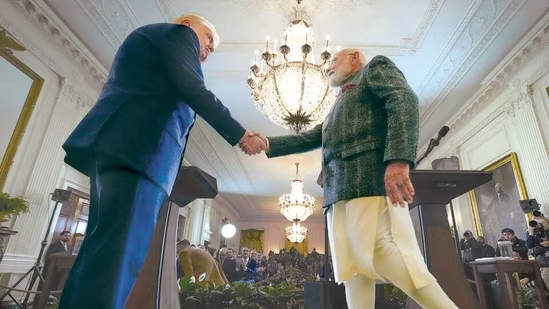
Amid escalating tensions between India and the US concerning Donald Trump’s imposition of 50 percent tariffs, analysts have reported that the US president perceives himself as “deceived” by New Delhi.
In a discussion with NDTV, US Strategic Affairs Specialist Ashley J. Tellis mentioned that Trump believes he was “cheated” since he did not receive acknowledgment for his supposed role in settling the India-Pakistan dispute in May 2025.
Tellis, who holds the Tata Chair for Strategic Affairs at the Carnegie Endowment for International Peace, also noted that Prime Minister Modi’s phone call to Trump about the ceasefire with Pakistan might have worsened the situation.
Tellis stated to NDTV, “In my view, he feels deceived that he wasn’t given the recognition he feels he deserved for resolving the India-Pakistan crisis in May 2025. I suspect that Prime Minister Modi’s call to him, intended to clarify the facts, ended up aggravating the matter instead of calming it.”
The backdrop to these events includes a terrorist incident in Pahalgam, Jammu and Kashmir, which resulted in 26 fatalities. In response, India executed airstrikes on militant bases in Pakistan and Pakistan-occupied Kashmir as part of ‘Operation Sindoor’. This military action led to a standoff, pushing both nations toward the brink of a fifth conflict.
Ceasefire Between India and Pakistan and Trump’s Purported Participation
India and Pakistan reached a ceasefire agreement on May 10, 2025, ending four days of conflict between the two neighbors. However, before officials from both countries could formally declare the ceasefire, Donald Trump posted on Truth Social, asserting that the US had mediated peace between India and Pakistan.
Since that time, Trump has repeatedly stated that he personally brokered the ceasefire between India and Pakistan, thereby preventing a possible nuclear confrontation. While Pakistan expressed gratitude to Trump and his administration, even proposing him for a Nobel Peace Prize, India has rejected the idea of any external involvement.
The Indian government clarified that although Trump, Vice President JD Vance, and Secretary of State Marco Rubio made phone calls, the ceasefire was finalized only after the Director General of Military Operations (DGMO) of Pakistan contacted his Indian equivalent.
Despite India’s rejection of US involvement or mediation, Trump has persisted in claiming credit for bringing stability to India and Pakistan, as part of his effort to secure a Nobel Peace Prize.
In a Truth Social post last month, Trump remarked, “I have ended 6 wars, and I assumed this one might be the simplest. But it isn’t—it’s challenging…India-Pakistan, we’re discussing major nations. Consider some of these other conflicts—look at Africa, for instance. Rwanda and Congo—that’s been ongoing for 31 years. We’ve successfully concluded 6 wars, not to mention that we completely eliminated Iran’s potential nuclear capabilities.” He made these comments while advocating for an end to the wars in Ukraine and Gaza.
As Trump continues to reiterate his claims, India maintains its position.
At a recent conference, Indian External Affairs Minister Dr. S. Jaishankar emphasized that India does not welcome any interference in its foreign policy, particularly regarding issues with Pakistan. He described this as a “red line” and further explained, “it is one matter to offer help, but it is quite another to claim mediation or to insist that an outcome agreed upon by India and Pakistan was not actually negotiated between them.”
Trump’s Deepening Dispute with India
A New York Times article from August indicated that Trump’s decision to levy 50 percent tariffs on India and criticize its purchase of Russian oil stems from Modi’s refusal to acknowledge Trump’s role in the ceasefire with Pakistan.
According to the report, being denied this recognition is a significant hurdle in Trump’s pursuit of a Nobel Peace Prize. The article also mentioned that this rejection exacerbated tensions, prompting Trump to implement steep tariffs on India and subsequently focus on its acquisitions of Russian oil, all while overlooking similar actions by China.
Additionally, the US president has apparently called off his planned trip to India for the Quad Summit in 2025.
Amid these strained relations, PM Modi’s recent visit to China for the SCO Summit has also displeased officials in the Trump administration. Meanwhile, Democrats have voiced worries that Trump’s approach could distance India further from the United States.

 Akshay Didwaniya
 Mayur Mohta
 Aditya Didwaniya

 Pratik Agrawal