

 The BRICS Times
Global oil prices barely budged on Monday even as U.S. President Donald Trump unveiled “Project Freedom,” a bold plan to guide stranded ships out of the blockaded Strait of Hormuz. Iran rejected the move outright, and markets stayed cool.

Oil Markets Unmoved After Trump Announces “Project Freedom”
Global oil prices stayed largely flat on Monday a clear signal that traders are far from convinced by U.S. President Donald Trump’s sweeping announcement to help neutral ships break free from the blockaded Strait of Hormuz. Brent crude, the world’s key oil benchmark, hovered just around $108 a barrel barely moving despite the dramatic White House declaration.
Trump on Sunday said the U.S. would “help free up” vessels stranded deep inside the Gulf trapped there since the U.S. and Israel launched a war on Iran in late February. He named the operation “Project Freedom” and said it would kick off from Monday. However, Trump gave very few operational details on how exactly the plan would play out.
Iran Pushes Back Hard
Iran wasted no time shooting the plan down. Senior Iranian officials made clear that Tehran has no intention of cooperating. Ebrahim Azizi the head of Iran’s parliament’s National Security Commission warned on Sunday that any “American interference” in the Strait of Hormuz would be seen as a direct violation of the fragile ceasefire both sides agreed to on April 7.
That ceasefire has done little to calm the waters literally. On Monday, the United Kingdom’s military reported a tanker was struck by “unknown projectiles” off the coast of the UAE. Hours before that, a bulk carrier reported being attacked by multiple small craft near Iran. The UK Maritime Trade Operations agency confirmed neither crew suffered casualties.
Project Freedom Rescue Mission or Traffic Solution?
June Goh a senior oil market analyst at Sparta in Singapore told reporters that Trump’s plan appears to be aimed more at saving stranded seafarers than at actually reopening the waterway for commercial oil traffic.
“Global observable oil inventories are starting to fall sharply, which should weigh on market sentiment more than political statements for a reopening of the strait,” Goh said.
“Normalising the flow through the Strait of Hormuz will take more than what Project Freedom is offering, whilst the yawning gap in oil supply will take months to resolve,” she added.
A Choke Point the World Cannot Afford to Ignore
The Strait of Hormuz is no ordinary shipping lane it carries roughly one-fifth of the world’s entire oil supply. Before the war broke out, an average of 129 vessels crossed through daily. That number crashed to just 20 ships on the last available tracking day a devastating plunge for global energy markets.
Goldman Sachs estimates that the combined impact of the Hormuz closure and strikes on energy infrastructure has slashed global daily oil output by a staggering 14.5 million barrels. Brent crude has surged nearly 50% since the conflict began and analysts warn prices will stay high long after any peace deal, because of the enormous backlog of unloaded energy cargo and the time it will take to clear Iranian mines from the waterway.
A Diplomatic Standoff With No Quick Fix
Trump said his representatives were having “very positive discussions” with Iran but the two sides remain far apart. Washington insists Iran must open the Strait and agree to a nuclear deal first. Tehran says it will keep Hormuz closed until the U.S. lifts its naval blockade. Both sides are digging in.
U.S. Central Command said military support for Project Freedom would include guided-missile destroyers, over 100 land and sea-based aircraft, unmanned platforms across multiple domains, and 15,000 service members. Yet Trump did not specify whether the operation would involve direct U.S. Navy escorts a proposal his own officials had previously ruled out as premature.
OPEC+ added another layer of complexity the cartel voted to raise output by 188,000 barrels per day in its first meeting since the UAE exited the group. Still, market losses stayed limited because a peace deal between Washington and Tehran looks nowhere close.
Stephen Innes of SPI Asset Management laid it out starkly: the oil market “remains the fulcrum, with hundreds of tankers, bulk carriers, and cargo ships still stranded across the Gulf, idling as storage constraints force producers to shut production simply because there is nowhere left to store it.”
With Iran blocking the strait, Trump’s plan lacking detail, and analysts bracing for months of supply disruption the world’s most critical energy chokepoint remains firmly shut.


 Akshay Didwaniya
 Mayur Mohta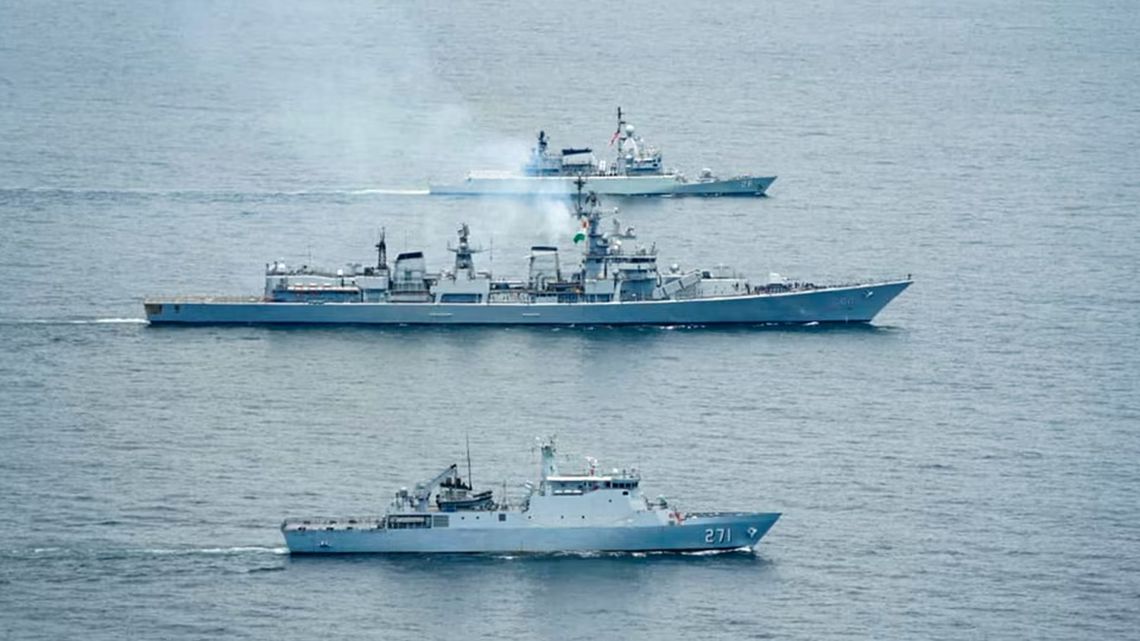
 Aditya Didwaniya

 Pratik Agrawal