 The BRICS Times
Facilitated by the Ministry of Home Affairs, the visit is being seen as a crucial step in the ongoing legal battles in UK courts, according to senior officials.
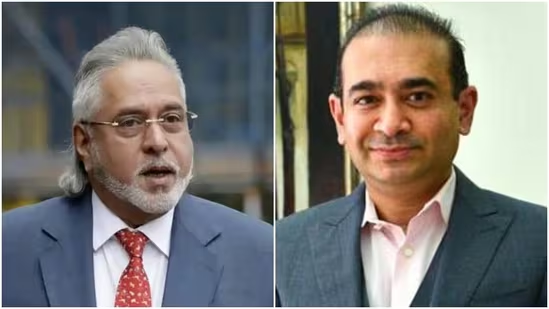
A team from the UK’s Crown Prosecution Service (CPS) recently carried out an inspection of Delhi’s Tihar Jail to evaluate the prison’s living conditions, an exercise directly linked to India’s efforts to bring back high-profile economic offenders such as Vijay Mallya and Nirav Modi. The Ministry of Home Affairs (MHA) coordinated the visit, which senior government representatives have described as a key development in the continuing extradition proceedings before British courts.
Officials familiar with the matter noted that the CPS delegation expressed overall satisfaction with the prison’s facilities and the care extended to inmates. Indian authorities are understood to have assured the visitors that, should the need arise, a separate “enclave” could be created within the jail to house prominent extraditees, thereby guaranteeing both security and international compliance in terms of treatment standards.
The findings from the inspection are expected to be conveyed positively to the British government, giving a boost to Indian agencies pursuing fugitives who have taken shelter in the UK. Three senior functionaries independently confirmed that the high-level exercise had been conducted in July. However, queries sent to the CPS media office in London and the British high commission in New Delhi went unanswered.
“A four-member team — two CPS experts and two British high commission officials — visited the Tihar prison in July to assess the prison conditions for extradition cases being pursued by CPS on behalf of the Indian government. They were largely impressed with the facilities available to the prisoners, including in high-security wards, and called them at par with international standards,” one of the officials revealed.
Another senior officer explained that the CPS members also examined high-security barracks and interacted with inmates during their visit. “Besides, they also had a meeting with senior officers at the MHA, ministry of external affairs, investigating agencies and Tihar to comprehensively discuss various aspects related to extradition of suspects from the UK and legal requirements of the CPS prosecutors representing India,” the officer added.
The issue of prison conditions has become central to several extradition battles. Fugitives such as arms dealer Sanjay Bhandari and diamond merchant Nirav Modi have argued in British courts that being sent to Tihar would expose them to risks of abuse, extortion, or violence from fellow prisoners or officials.
Indeed, prison facilities were a deciding factor when the UK High Court, on February 28 this year, denied India’s request to extradite Bhandari. The court further prevented India from challenging this decision before the Supreme Court in April, effectively allowing Bhandari to remain free in London. Similarly, on April 11, Westminster Magistrates’ Court chief magistrate Paul Goldspring granted unconditional bail to Virkaran Awasty and his wife Ritika Awasty, accused in a ₹750 crore fraud case. Goldspring highlighted the earlier Bhandari judgment, stating that “in the absence of assurances that Awasty won’t be held in Tihar, or if he is, that the issues raised in Bhandari (case) will not apply to him, the real risk remains.”
These rulings set off alarm in New Delhi, prompting CPS to advise Indian authorities to issue a sovereign assurance that any extradited suspect would not face torture or harsh treatment, in line with Article 3 of the European Convention on Human Rights (ECHR). As first reported in June, the Indian government subsequently provided such a guarantee to the UK, clarifying that the Awastys would not be interrogated if returned.
Government records show that India has 178 pending extradition requests across multiple countries, covering economic offenders, terrorists, and others. Nearly 20 of these are with the United Kingdom. Among the cases being actively pursued are those of Vijay Mallya, Nirav Modi, Hajra Memon – widow of underworld figure Iqbal Mirchi – her sons Asiq Iqbal Memon and Junaid Iqbal Memon, along with several UK-based Khalistani leaders.

 Aditya Didwaniya
 Akshay Didwaniya


 Mayur Mohta