
 The BRICS Times
“Blood Moon” happens when the Sun, Earth, and Moon align perfectly, causing Earth’s shadow to cover the Moon and turn it a striking red shade.
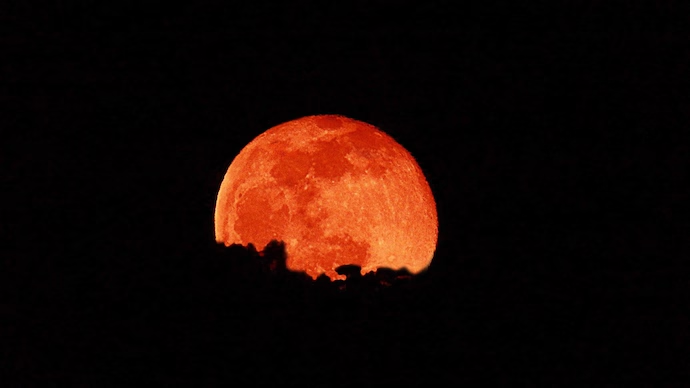
Skywatchers in India and many other parts of the world are in for a rare astronomical delight this Sunday, as the skies will showcase a stunning total lunar eclipse visible across the country.
The celestial spectacle, more commonly referred to as a “Blood Moon,” takes place when the Sun, Earth, and Moon fall in alignment, allowing Earth’s shadow to cover the lunar surface and paint it in a dramatic red tone. This extraordinary sight has fascinated, and at times unsettled, civilizations for generations.
Regions across Asia, particularly India and China, will enjoy the clearest views of the eclipse, while complete visibility will also extend to the eastern edges of Africa and western parts of Australia, according to Agence France-Presse. Observers in Europe and much of Africa will be able to see only a partial eclipse as the Moon rises, while both North and South America will miss the event entirely, leaving enthusiasts there without a glimpse of this awe-inspiring phenomenon.
The total lunar eclipse, popularly referred to as the “Blood Moon,” will unfold beginning at 11:00 PM IST on September 7 and reach its conclusion by 12:22 AM IST on September 8. The Moon, however, will start slipping into Earth’s outer shadow slightly earlier, around 10:01 PM IST, when the penumbral phase begins.
Unlike solar eclipses that require protective glasses or indirect viewing methods such as pinhole projectors, lunar eclipses are safe to watch without any equipment. The AFP report emphasized that viewers can simply enjoy the spectacle with the naked eye, as long as skies remain clear and the surroundings are suitable for an unobstructed view.
This marks the second total lunar eclipse of the year, following the one seen in March, and is also the lengthiest since 2022. Astronomers, whether professional or amateur, regard this as a thrilling lead-up to a highly awaited total solar eclipse that is expected next year.
On August 12, 2026, a rare solar eclipse will grace the skies over a limited stretch of Europe, particularly across Spain and Iceland. It will be the first complete solar eclipse seen on mainland Europe since 2006, though several other countries will still witness significant partial eclipses. In Spain, the path of totality is forecast to extend roughly 160 kilometres (about 100 miles) between Madrid and Barcelona, though neither of the two cities will experience the eclipse in full.
Explaining the distinctive crimson glow of the Moon during this event, Ryan Milligan, astrophysicist at Queen’s University Belfast in Northern Ireland, noted that the phenomenon results from how sunlight interacts with Earth’s atmosphere. “The Moon appears red during lunar eclipses because the only sunlight reaching it is reflected and scattered through the Earth’s atmosphere. Blue light is scattered more easily than red, leaving the Moon with its iconic ‘bloody glow’,” AFP quoted Milligan as saying.


 Aditya Didwaniya
 Akshay Didwaniya



 Mayur Mohta