
 The BRICS Times
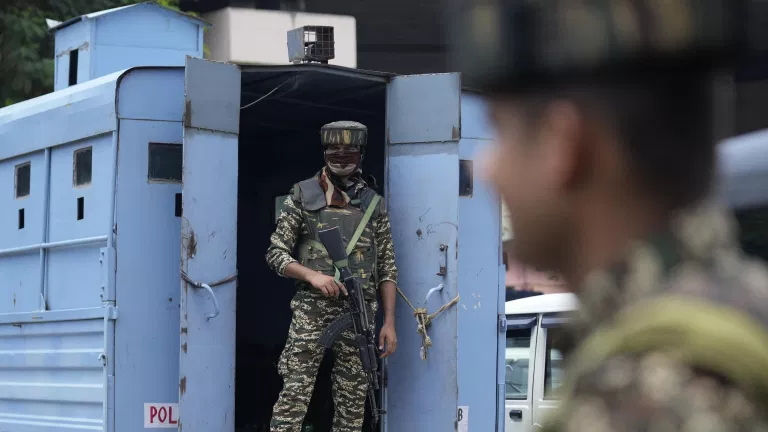
During the Presidential Reference hearing, violent protests in Nepal and Bangladesh were discussed. CJI B.R. Gavai remarked, “We are proud of our Constitution, look at the condition in our neighboring countries, we saw Nepal too.” Non-BJP ruled states concluded their arguments in court today.

The Supreme Court continued hearing the Presidential Reference case for the ninth consecutive day on Wednesday, September 10. On this day, non-BJP governed states wrapped up their arguments opposing the reference. Earlier, the Supreme Court had set a time limit for the President and Governors regarding decision-making. Following that, the President referred 14 constitutional questions to the court, seeking clarity through the Presidential Reference.
Chief Justice Mentions Nepal Crisis
During the discussion on the President’s reference, Chief Justice B.R. Gavai brought up Nepal’s constitutional crisis. He stated, “We are proud of our Constitution, just look at the situation in our neighboring countries. We witnessed Nepal.” In response, Justice Vikram Nath added, “Yes, even in Bangladesh.”
Centre’s Stand in the Supreme Court
The central government argued that a Governor’s approval is not a mere formality but an essential constitutional step. Solicitor General Tushar Mehta opposed the claim made by states that a Governor’s decision can undergo judicial review. The Centre maintained that while Governors do not hold voting rights in assemblies, they remain integral parts of the legislature. Under Article 200, a bill completes its journey into law only after receiving a Governor’s assent. The Solicitor General further argued that Governors exercise discretion based on their constitutional duty to protect, preserve, and uphold the Constitution.
Non-BJP States Complete Their Arguments
Non-BJP ruled states presented their full arguments opposing the reference. Solicitor General Tushar Mehta, representing the Centre, delivered his rejoinder. He clarified that his position was never that Governors could sit indefinitely on a bill. He explained that Article 200 provides Governors with four distinct options. Chief Justice Gavai then referred to Gopal Sankaranarayanan’s submission, stressing that since the matter involves a Presidential Reference, a counter-response does not arise.
Kapil Sibal, acknowledging the technical correctness of arguments, remarked that the issue remains highly complex. Justice Vikram Nath also noted the vast scale of the matter, with written submissions extending to nearly 25,000 pages. The Solicitor General asserted that the Presidential Reference is not just an advisory opinion but a declaration of law, as it involves constitutional interpretation.
Andhra Pradesh Government Supports Centre
On the other hand, the Andhra Pradesh government extended support to the Centre on almost all issues except one. Advocate Siddharth Luthra, representing the state, said that Andhra Pradesh stands with the Centre on every matter except the claim that a state government cannot file a writ petition under Article 32 of the Constitution.
Hearing to Continue
The Supreme Court will continue the hearing on the Presidential Reference on Thursday, September 11. Chief Justice Gavai indicated that proceedings should conclude by 1 PM. The matter is being heard by a Constitution Bench of five judges, including Chief Justice B.R. Gavai, Justice Surya Kant, Justice Vikram Nath, Justice P.S. Narasimha, and Justice A.S. Chandurkar.

 Aditya Didwaniya
 Akshay Didwaniya
 Mayur Mohta


 Pratik Agrawal