

 The BRICS Times
A detailed study shows that while India’s overall rainfall has declined, western states such as Rajasthan and Gujarat are experiencing a surge in extreme rainfall events, reshaping the monsoon’s behaviour.
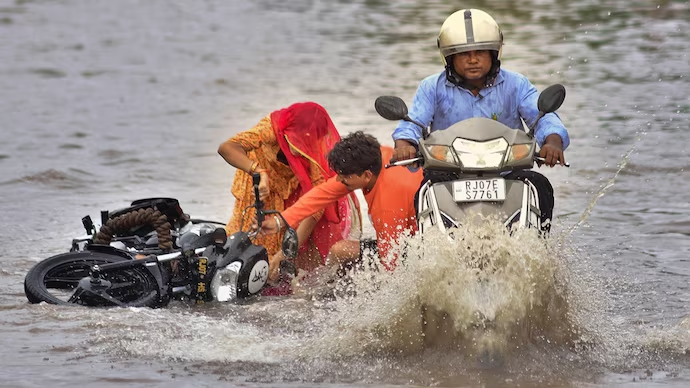
The current monsoon season has brought surprising rainfall patterns to India. States like Rajasthan and Gujarat—traditionally arid and semi-arid—have witnessed much higher rainfall compared to the country’s northeastern belt, which is usually the rainiest region. This reversal comes despite a long-term decline in India’s overall average monsoon rainfall. What is rising instead, scientists warn, is the occurrence of extreme rainfall events (EREs), where massive amounts of rain fall in short bursts.
A recent study published in Springer Nature sheds light on this shift. Researchers from the Indian Institute of Technology (IIT) Bhubaneswar examined long-term data to track how rainfall extremes have evolved, particularly in the dry landscapes of northwest India. Their findings show a clear increase in both localised and widespread extreme events in states such as Rajasthan, Gujarat, and the Godavari basin.
To analyse the phenomenon, the team used high-resolution datasets from the Indian Meteorological Department (IMD), covering the period from 1991 to 2022. They divided rainfall events into three categories:
- Widespread events: When more than 10 regions are affected simultaneously.
- Localised events: When rainfall impacts 2–9 regions.
- Generalised events: A combination of the two.
In just over three decades of data, the researchers recorded 210 widespread events and 468 localised events across India’s arid and semi-arid belts. Their study revealed that widespread extreme events are accelerating at a faster rate than localised ones, particularly across Gujarat and surrounding regions.
The reasons behind this spike lie in atmospheric and oceanic interactions. Many of these extreme rains are linked to low-pressure systems forming over western India. These systems pull large amounts of moisture from both the Arabian Sea and the Bay of Bengal, intensifying rainfall when they converge with regional weather systems. The study also highlights disturbances occurring at middle levels of the atmosphere—between three and six kilometres above the ground—as key triggers for these events.
The research points to a complex mix of factors driving EREs:
- Rising vertical air currents and storm-like circulation patterns.
- Mid-atmosphere heating caused by condensation of water vapour.
- The presence of frozen particles, especially snow, which affect the release of latent heat and vertical temperature balance.
Interestingly, the study notes that snow within the atmosphere plays a far more important role than cloud ice in influencing the intensity of rainfall. By cooling and stabilising the atmosphere, snow alters heat release and temperature gradients, ultimately shaping rainfall outcomes. In contrast, moisture static energy (MSE) was found to influence rainfall trends, but less directly than these other mechanisms.
The findings clearly point to an upward trajectory of both widespread and localised extreme rainfall events in western India. This means regions that were once considered water-scarce are now increasingly facing the dual challenge of floods and waterlogging.
Researchers emphasise that this changing rainfall behaviour cannot be ignored. Without targeted climate adaptation strategies, the intensifying frequency and strength of these events could have severe impacts on infrastructure, agriculture, and vulnerable communities. Roads, dams, irrigation networks, and farmlands in western India are particularly at risk if measures are not taken to adapt to this shifting climate reality.
By drawing attention to these growing extremes, the study underlines the urgent need for science-driven policy interventions. It also reinforces the broader message that India’s monsoon is no longer behaving in predictable patterns—demanding renewed focus on resilience and preparedness.


 Akshay Didwaniya
 Aditya Didwaniya


 Pratik Agrawal

 Mayur Mohta