 The BRICS Times
A lunar eclipse occurs when Earth passes directly between the Sun and the Moon, blocking sunlight and casting its shadow on the lunar surface.
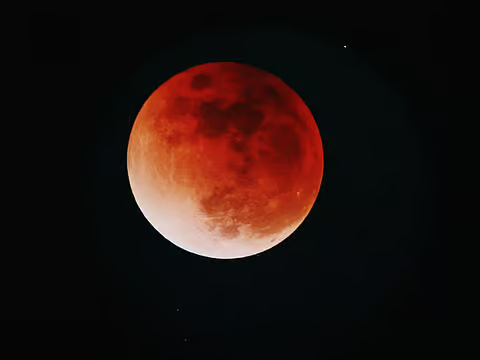
The next total lunar eclipse, also called Chandra Grahan, will take place on September 7–8, 2025. The event will be most prominently visible across Asia and Western Australia, while parts of Europe, Africa, eastern Australia, and New Zealand will catch a partial view. However, people in the United States will miss out on this celestial show.
A lunar eclipse happens when Earth positions itself between the Sun and the Moon, preventing sunlight from reaching the Moon. During a total eclipse, the Moon takes on a striking reddish or copper hue, popularly known as a “blood moon.”
Eclipse Timeline (UTC):
- Penumbral phase starts: 15:42
- Partial eclipse begins: 16:39
- Total eclipse starts: 17:31
- Peak eclipse: 18:11
- Total eclipse ends: 18:52
- Partial eclipse ends: 19:44
- Penumbral phase ends: 20:41
When Can India See It?
For viewers in India, the total lunar eclipse will begin at 11:01 p.m. IST on September 7. The Moon will go through penumbral, partial, and total phases, with each stage offering different views depending on location. The most breathtaking sights are expected across Asian regions and Western Australia.
The entire event will last 5 hours and 27 minutes, while the total eclipse phase alone will span about 1 hour and 21 minutes, as per Space.com.
Why Does the Moon Appear Red?
NASA explains that during a total lunar eclipse, Earth’s atmosphere filters sunlight. Shorter wavelengths like blue and violet scatter away, while longer red and orange wavelengths bend around Earth and fall on the Moon. This gives it a glowing red tint. The presence of dust or clouds in the atmosphere can make the shade appear even darker.