 The BRICS Times
Tectonic shifts and climate change together are driving frequent and destructive earthquakes across India, Pakistan, and Afghanistan.
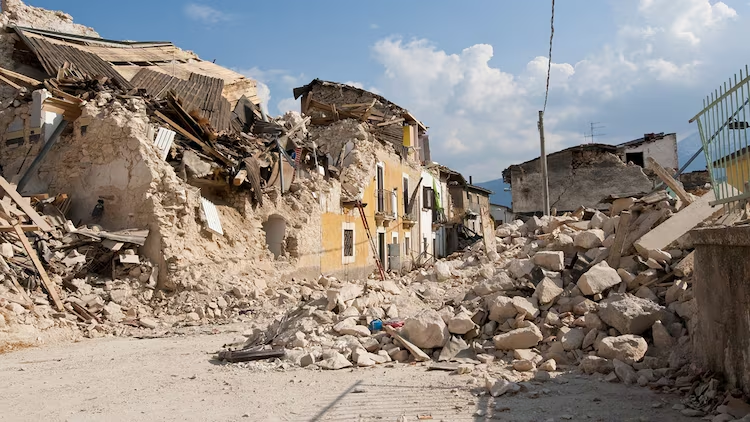
A devastating earthquake measuring 6.0 struck Afghanistan, leaving at least 812 dead and more than 2,800 injured. The tragedy underscores the heightened seismic dangers in South Asia, particularly in India, Pakistan, and Afghanistan.
India has remained prone to quakes since the catastrophic Bhuj earthquake of 2001. Assam was shaken by a powerful tremor in 2021, while Delhi reported over 17 small quakes between January and July this year. Pakistan, too, has seen activity, with moderate quakes affecting Karachi in March and June.

The Hindu Kush and Himalayan belts have increasingly become epicenters of frequent seismic disturbances.
WHY SO MUCH UNREST UNDERGROUND?
The chief culprit is the collision of the Indian and Eurasian tectonic plates. The Himalayan crust remains fragile, and the Indian plate continues its steady northward drift of around five centimeters per year, crashing into the Eurasian plate. This movement generates active fault lines that regularly release accumulated energy through earthquakes.
Research from the Ocean University of China reveals that the Indian plate is not gliding smoothly under the Eurasian plate. Instead, it is tearing apart and sinking into the mantle in a process called delamination. Here, the heavier bottom portion of the plate detaches and sinks, while the lighter part continues its forward push. This fracturing of the crust magnifies seismic hazards.
The geological complexity of the region—towering mountain ranges, deep valleys, and thick sedimentary layers—adds to the instability. Constant uplift and deformation cause repeated ground shaking across the Himalayan foothills, northern India, Afghanistan, and Pakistan.
THE HIDDEN INFLUENCE OF CLIMATE CHANGE
Melting glaciers in the Himalayas, fueled by rising global temperatures, are reshaping seismic risks. Studies warn that up to 80% of Himalayan glaciers could vanish by the century’s end.
As ice mass disappears, the Earth’s crust adjusts to the reduced load by shifting vertically. Meanwhile, meltwater percolates into the ground, lowering friction between plates and making earthquakes more likely.
While tectonic motion remains the primary trigger, climate change is amplifying both the frequency and intensity of earthquakes in South Asia.
Experts emphasize the urgent need for disaster preparedness, cross-border collaboration, and climate-resilient strategies, along with reducing carbon emissions, to safeguard the region from future seismic disasters.


 Aditya Didwaniya
 Akshay Didwaniya



 Mayur Mohta