

 The BRICS Times
This event highlights France’s political instability, where President Emmanuel Macron struggles to balance stability with economic reforms. All eyes remain on Macron as he decides who will be appointed the next Prime Minister.
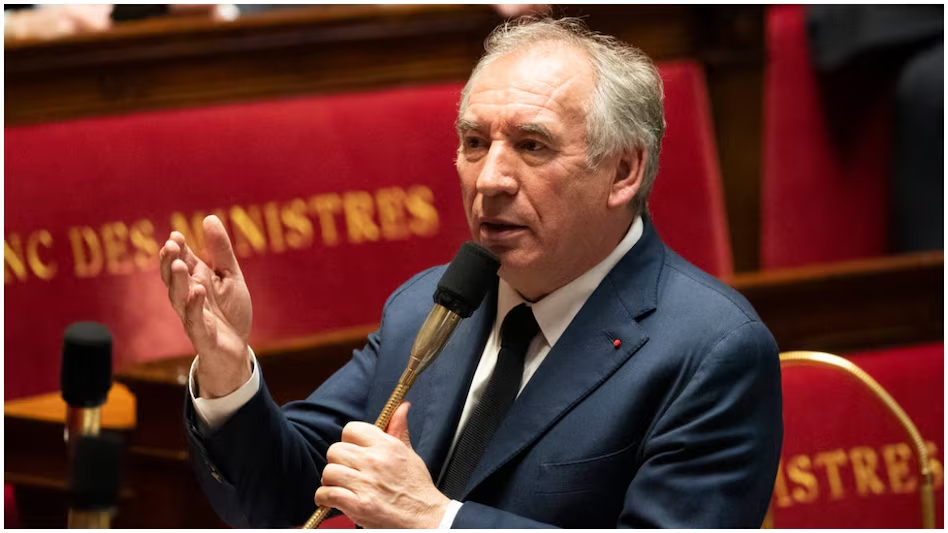
France witnessed heightened political turmoil on Monday after Prime Minister François Bayrou failed to defend his government in a no-confidence motion in parliament. The development forces President Emmanuel Macron to begin the process of appointing his fifth prime minister in just two years.
François Bayrou, 74, who held the prime minister’s post for only nine months, is set to submit his resignation today. He had relied on a no-confidence vote to secure approval for his government’s €44 billion ($51.5 billion) savings package. This plan aimed to reduce France’s deficit, which has risen to double the European Union’s 3% limit.
Currently, France’s debt equals 114% of its GDP. According to Reuters, Bayrou stressed that the savings plan included in the 2025–2026 budget was vital to restoring financial credibility. However, opposition parties, already focused on the 2027 presidential election, refused to lend their support. Ahead of the crucial vote, Bayrou warned lawmakers, “You may topple my government, but you cannot erase reality. Spending will continue to rise, and the already unbearable debt burden will grow heavier and costlier.” Despite his appeal, lawmakers overwhelmingly rejected his proposal.
Opposition groups, particularly the National Rally and the Left-wing coalition, denounced Bayrou’s savings plan as an attack on social welfare and public services. They argued that the measures would hurt middle and lower-income citizens while offering tax relief to the wealthy. Analysts see this opposition as a calculated move ahead of the 2027 elections, where parties seek to strengthen their position. The crisis exposes the deep political instability in France, where President Macron now faces the challenge of balancing stability with pressing economic reforms.
President Macron is now searching for a leader capable of building consensus among fragmented parliamentary blocs. The task is made harder by France’s recent credit rating downgrade and the European Union’s warning to impose stricter measures for deficit reduction. Finding a suitable prime minister will not be easy, as no single party holds a clear majority in parliament. Meanwhile, French citizens are increasingly anxious about rising debt and ongoing political uncertainty. The country now waits to see whom President Macron appoints as the next prime minister.


 Mayur Mohta
 Akshay Didwaniya



 Aditya Didwaniya